COBOL to Java Migration Complexity in Financial Systems
The common pitch for COBOL-to-Java migration treats it as a translation exercise: take old syntax, produce new syntax, move on. That framing breaks down almost immediately in financial systems. COBOL is a procedural language organized around record-oriented data, fixed-width fields, packed decimals, and batch execution, and none of those design assumptions map cleanly onto Java's object-oriented, heap-based, Unicode runtime. Financial institutions have run COBOL in production for decades, and that code has absorbed wave after wave of regulatory change, product variation, and edge-case patches, almost none of which were written down anywhere except in the code itself. A COBOL migration ends up being reverse engineering, paradigm conversion, data transformation, compliance re-certification, and organizational change, all running at the same time, and each layer below unpacks one piece of why that is true.
Undocumented business logic as the deepest technical risk
The hardest part of a COBOL migration is not the code, which is difficult enough to read, but the logic that nobody currently employed by the institution fully understands. Decades of pricing rules, credit scoring models, premium calculations, claims adjudication logic, fee schedules, and settlement rules live inside these systems, built up through years of patches. Many of these rules were never written into a requirements document. The COBOL source code is the only specification that exists.
Compliance hooks compound the same problem in a different shape. AML and KYC workflows, PCI DSS controls, Basel and IFRS reporting transformations, and audit trail generation were added to these systems piece by piece as regulations changed over the years, often with no documentation attached to the change. A migration team cannot just read the code and translate what it says, because nobody tracked how the code's behavior and the business's actual intent drifted apart over the years. The team has to reconstruct what the system means before it can decide how to rebuild it, and that reconstruction depends on domain experts who understand both the old system's mechanics and the business rules it was built to enforce. Involving business owners, product leads, and subject matter experts to check translated logic against historical outputs and known edge cases is a requirement of the organization, not just the toolchain, rather than a nice-to-have step tacked onto the technical plan.
Traceability requires that every original COBOL routine have a documented line back to the Java component that replaces it, and to the test cases that prove the replacement behaves the same way. That matters for correctness, and it matters just as much when a regulator later asks the institution to demonstrate that nothing changed in the logic a customer or examiner relied on.
The procedural-to-object-oriented shift as a design problem, not just a syntax problem
Even once the business logic is fully understood, there remains the separate problem of how that logic has to be restructured. A direct transliteration of COBOL into Java, line by line, produces code that is no easier to maintain than what it replaced. A straight, mechanical conversion usually results in poorly organized Java, a system that ends up just as hard to manage as the COBOL it replaced, sometimes nicknamed "JOBOL" for exactly that reason.
The individual constructs each demand a real design decision, not a substitution rule. Java gives you switch statements or switch expressions for EVALUATE and WHEN, but that mapping only works cleanly when you think through the control flow that the syntax represents. REDEFINES, OCCURS, and group items have to become typed classes, arrays, and collections. Someone has to decide what the proper Java type model looks like, since COBOL's memory layout gives no such guidance. COPY and REPLACE copybooks need full resolution, including any copybooks nested inside other copybooks, before a single line of the logic they define can be trusted. EXEC SQL calls into DB2, EXEC CICS transaction logic, and VSAM file access have no drop-in Java equivalent at all; each requires a deliberate redesign onto JDBC, JPA or Hibernate, Spring Data, or comparable service patterns. EBCDIC-encoded fields and fixed-width record layouts need explicit, field-level conversion into Unicode and properly typed models.
Of all these decisions, the one with the most direct financial consequence is how decimal arithmetic gets handled. COBOL's packed decimal format, COMP-3, performs exact arithmetic. Java's native double and float types do not. Converting COMP-3 fields into a floating-point primitive introduces systematic rounding errors into financial calculations, errors that compound silently across millions of transactions before anyone notices a discrepancy. You should map it to Java's BigDecimal instead, configured with the same scale and precision defined by the original PIC clause in the COBOL source. Using double to keep the code simpler is a production defect, built in from day one.
None of this means Java is a poor fit for replacing COBOL's operational patterns. Spring Batch maps well onto COBOL's batch job structure, and the broader Spring and Jakarta EE ecosystem covers transaction management, messaging, and data access, so it can match what the mainframe environment already does. You need architects who understand both the Java side and the COBOL execution model it replaces to apply these frameworks correctly, and that combination of skills is genuinely rare.
Data format incompatibilities that sit beneath the code layer
Correct, well-designed Java code will still produce wrong answers if the data feeding it was encoded in a format Java doesn't read the same way. Mainframe COBOL systems typically store data in EBCDIC character encoding and COMP-3 packed decimal binary formats. Java works in Unicode and standard binary types. The mismatch between the two appears only once data is actually read and processed, when it surfaces as corrupted values. If you convert this layer incorrectly, you get data corruption and compliance failures, not cosmetic display problems.
Fixed-width record layouts carry a structural assumption baked into decades of stored data; it is not just a formatting detail. You need explicit, field-by-field mapping for every distinct record type, across every data store the institution maintains, to migrate that data into Java's typed object model. The scope of what's affected tends to be larger than migration teams expect going in: core banking data, settlement records, regulatory reporting extracts, audit logs, and historical transaction archives may all sit in legacy formats that predate the migration by years or decades.
You can't validate that the conversion worked with a one-time check; it takes rigorous, ongoing reconciliation. Nightly processing runs, settlement batches, and regulator-facing data extracts all need to be run in parallel against the COBOL originals to confirm the converted records produce identical output. You need reconciliation KPIs built around balance matching and transaction matching in the testing plan from the start, not as an afterthought once the Java system is already live.
Compliance hooks compound the same problem in a different shape.
How compliance obligations compound every technical decision
Compliance is a layer of governance overhead that sits on top of every step a COBOL migration already requires. Any module touching AML or KYC workflows, PCI DSS scope, Basel or IFRS regulatory reporting, or audit trail generation needs its own governance and validation plan before a developer is allowed to touch it. Treating a regulatory-focused inventory of these modules as a distinct prerequisite step, separate from the general technical inventory, reflects how much slower and more deliberate this part of the work has to be.
COBOL systems that have run in production for decades carry audit trails and compliance records that regulators already trust. Migrating to Java means rebuilding those frameworks from scratch in a new environment, which demands extensive testing and, in many cases, explicit regulator approval before the new system is allowed to go live. The EU's Digital Operational Resilience Act, which took effect in January 2025, raises the stakes further: it requires demonstrated operational resilience and threat-led penetration testing that most legacy financial systems were never designed to pass, and it places direct accountability on a bank's management body to approve ICT risk frameworks and show active oversight of them. Leaving a migration half-finished or indefinitely delayed is a board-level liability under that regime, not simply a backlog item for the technology team.
The accountability runs to named individuals, not only institutions. That is what personal accountability looks like in practice under the UK's regulatory framework.
Every one of these obligations lands directly on the Java replacement system. It has to support enterprise-grade encryption, audit logging, and full traceability to meet the same compliance standards the COBOL system satisfied, and in most cases the new system needs more explicit, more thoroughly documented controls than the legacy environment ever required. Updated encryption, audit logging, and traceability have to be designed into the Java system from the start. Retrofitting them after go-live is not a viable sequencing choice.
What the TSB failure reveals about underestimating migration complexity
TSB Bank's migration failure is often told as a story about COBOL being unreliable. It is better read as a story about what happens when a migration team fails to account for undocumented interdependencies, compliance governance, and organizational readiness all at once. The recovery cost exceeded £330 million. The FCA's enforcement action against TSB was not a response to a software bug. The regulator found that TSB had failed to plan for the IT migration properly and lacked adequate risk management systems, and the sanction fell on that governance failure specifically.
That failure profile maps directly onto the layers described above. Undocumented dependencies between systems went unaccounted for. Compliance governance around the migration did not meet the standard regulators expected. Validation before and during cutover was not sufficient to catch the problems before customers felt them. TSB's experience does not stand as an argument against migrating COBOL systems at all, because plenty of institutions have done so successfully. It stands as an argument against treating migration complexity as something speed and scale can manage on their own, in place of phased planning, parallel validation, and governance that's documented at every stage.
What distinguishes a migration that survives this complexity from one that doesn't is largely a matter of sequencing and validation discipline; migration strategy itself becomes the decisive variable.
The strangler fig approach for financial COBOL systems
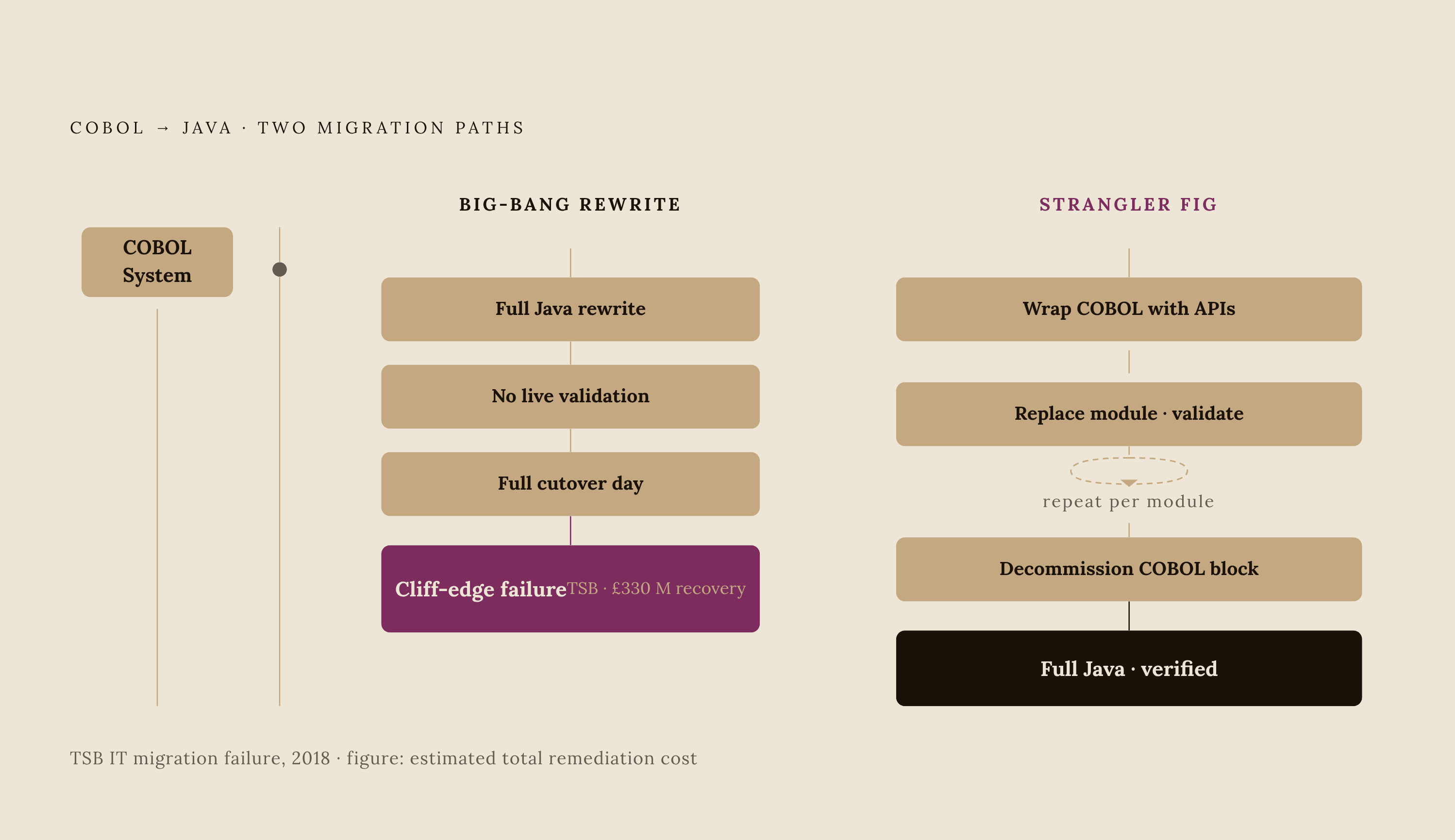
Put the layers together, undocumented logic, the procedural-to-object-oriented shift, data encoding mismatches, and compliance governance, and a full big-bang rewrite becomes the highest-risk strategy available for a financial COBOL system. The failure pattern is consistent: an organization commits a large budget to a complete rewrite, burns through most of the project timeline, and either cancels the effort outright or absorbs recovery costs on the scale of TSB's £330 million, because the new system cannot handle edge cases that the COBOL system had accumulated decades of patches to cover.
The strangler fig approach avoids that cliff edge by design. COBOL gets wrapped with APIs, and functionality gets replaced module by module, with each increment validated against the still-running COBOL system before anything gets decommissioned. This is what the incremental migration model actually looks like in practice: COBOL programs get replaced with Java equivalents one at a time, the system runs as a hybrid of both languages for a period, and it only becomes pure Java once every module has been replaced and verified. The main risks with this approach are the hybrid state lasting longer than originally planned, and the need for careful, deliberate interface design wherever COBOL and Java components have to talk to each other.
A related option, parallel rewrite, builds the full Java system alongside the running COBOL system and checks their outputs against each other continuously before cutover. This suits mission-critical systems like payments and payroll processing, where any interruption in continuity carries real cost to customers and to the institution. Its main cost is straightforward: running two complete systems side by side for the duration of the migration, which is expensive but buys the ability to catch discrepancies before they reach production.
Both approaches share the same underlying logic. They let a team validate against decades of accumulated COBOL behavior incrementally, rather than betting an entire institution's operations on a single cutover date and discovering the gaps only after customers are affected.
Sources
- Portable and Secure CI/CD for COBOL: Lessons from an Industrial Migration
Provided context on industrial COBOL migration challenges, including CI/CD patterns and lessons about hybrid COBOL-Java states during incremental migration.